When did these lineages last share an ancestor?
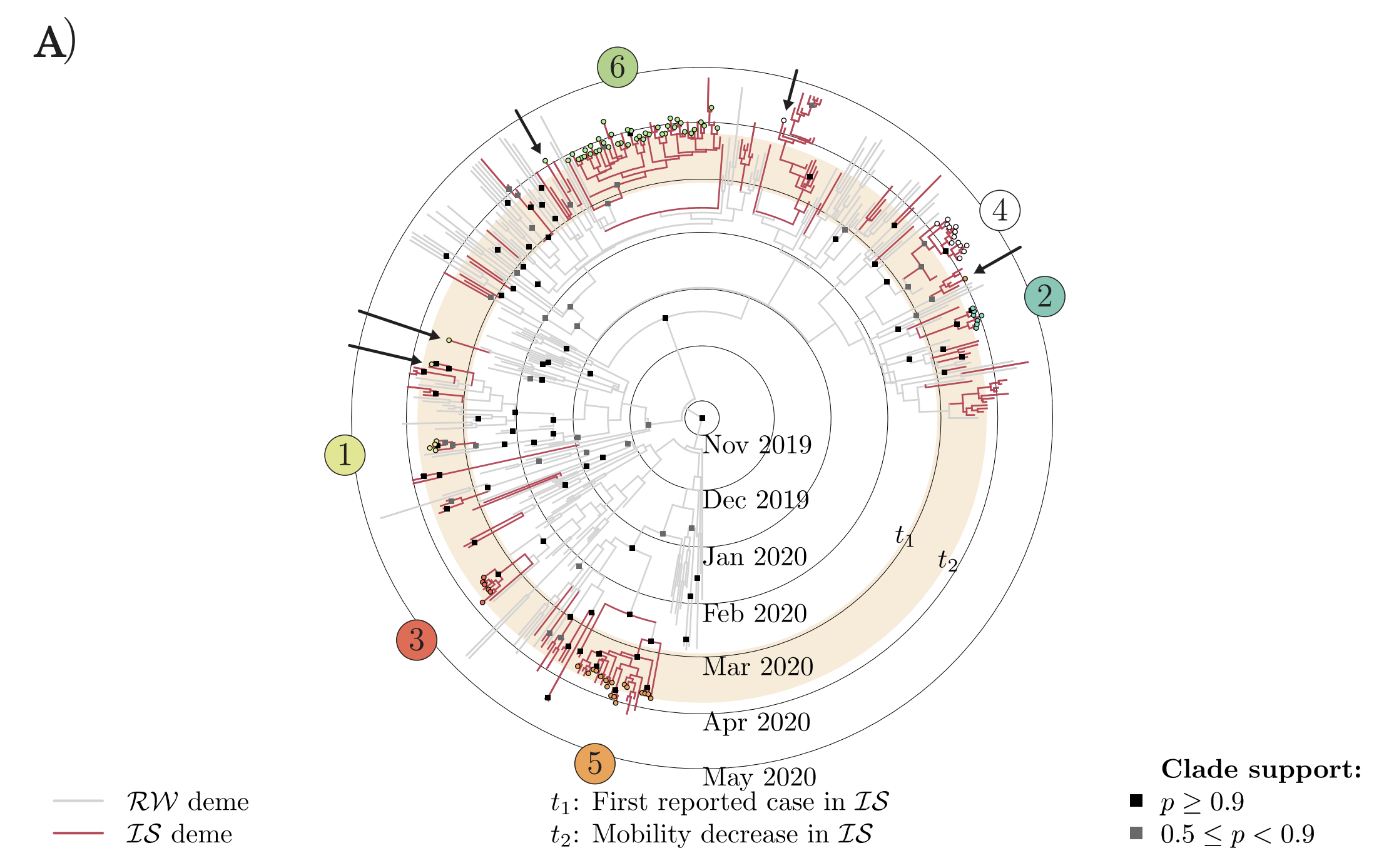
SARS-CoV-2 genomes from New Zealand's first COVID-19 wave.
- Rings are calendar months. Every branching point has an estimated date.
- Red is the New Zealand deme, grey the rest of the world. Each red cluster is a separate introduction.
- $t_1$ first reported case, $t_2$ mobility decrease. Dated ancestors let you ask whether a lineage arrived before or after the border response.
Figure 4A of Douglas et al. (2021), Virus Evolution 7(2):veab052, CC BY
The tips are dated. The ancestors are not.
- We know exactly when each sample was collected. Those dates are data.
- Nobody observed the ancestors. Every internal date on that figure is an estimate, and it has a posterior distribution, exactly like any other parameter in L8.
- So the answer to "when did this lineage arrive?" is never a single date. It is a date plus a 95% credible interval.
- The squares on the figure are the same posterior clade probabilities from L8, and the tree itself is a maximum clade credibility tree: a summary of many sampled trees, not a single answer.
Today's question: what has to be true before a tree can carry a calendar axis at all?
Where we are going
- So far a tree has had branch lengths, but no units. Today they get one: time.
- The sequence data do not record time. They record genetic distance, which is rate multiplied by time. Those two cannot be separated by sequences alone.
- A calibration, a dated fossil or a dated sample, breaks the tie and puts the tree on a scale of years.
- Real lineages do not all evolve at one rate, so we let the rate vary across the tree: a relaxed clock.
$\color{red}{g}$ is the time tree: the tree whose branch lengths are
durations. This is the tree the tree prior $P(\color{red}{g}|\color{blue}{\Theta})$
acts on, and the one we have been drawing all along.
$T$ is the substitution tree: the same tree, but with branch lengths in
expected substitutions per site. This is the only tree the likelihood
$\Pr(D|T)$ can see.
$\color{darkgreen}{\mu}$ is the clock rate that converts one into the other.
Genetic distance = rate $\times$ time
The strict molecular clock parameterization

A single rate $\color{darkgreen}{\mu}$ stretches the time tree $\color{red}{g}$ into the substitution tree $T$. The likelihood only ever sees $T$.
Non-identifiability of rate and time

A fast rate over a short time and a slow rate over a long time give the same genetic distances, so they have the same likelihood. No amount of extra sequence data separates them. We need information from outside the alignment.
Identifiability via node calibrations
Suppose fossil evidence shows the common ancestor of species A, B and C lived 25-35 Mya.

With a strict molecular clock, the age of a single node is enough to interpolate and extrapolate the ages of all the others. Once one node age calibrates the tree, the genetic distances separate into an absolute rate and divergence times.
Identifiability via leaf calibrations
Suppose sample C is ancient DNA from subfossil remains dated to 20 thousand years ago.

Calibration also works when the tips have different ages: ancient DNA, or virus samples collected on known dates. This is what dates the SARS-CoV-2 tree we started with. The genomes were sequenced over a few months, and the virus evolves fast enough for that spread of sampling dates to calibrate the clock on its own.
Genetic distance = rate $\times$ time
The relaxed molecular clock parameterization

Now every branch has its own rate, so $\color{darkgreen}{\vec{\mu}}$ is a vector rather than a single number. Lineages really do differ in generation time, mutation rate and selection, so this is usually the more realistic assumption.
A relaxed clock makes the problem harder, not easier

With one rate per branch there are far more ways to reproduce the same genetic distances. The extra freedom is only pinned down by the priors: how much rate variation we say is plausible ($\color{darkgreen}{P(\vec{\mu})}$) and what shape of tree we say is plausible ($P(\color{red}{g}|\color{blue}{\Theta})$). Divergence dates from a relaxed clock are therefore genuinely sensitive to those priors, which is why they must be reported.
How much rate variation should we allow?
Each branch draws its rate independently from one distribution, usually a lognormal. Two sister lineages are no more alike than any other pair. This is the common default.
The rate evolves along the tree, so a branch tends to resemble its parent. Biologically appealing when rate shifts track inherited traits such as body size or generation time.
- Either way, one parameter controls how much the rates are allowed to differ. Estimate it rather than fixing it: if the data support a single rate, that parameter will shrink towards zero and you recover the strict clock.
- The choice matters most when the calibrations are few and the dates far from them.
Bayesian phylogenetic posterior with a molecular clock
Strict molecular clock:
$$T = \color{darkgreen}{\mu} \times \color{red}{g}$$
$$P(\color{red}{g}, \color{darkgreen}{\mu}, \color{blue}{\Theta}|D) \propto \Pr(D|T)\;P(\color{red}{g}|\color{blue}{\Theta})\;\color{darkgreen}{P(\mu)}\;\color{blue}{P(\Theta)}$$
Relaxed molecular clock:
$$T = \color{darkgreen}{\vec{\mu}} \star \color{red}{g}$$
$$P(\color{red}{g}, \color{darkgreen}{\vec{\mu}},\color{blue}{\Theta}|D) \propto \Pr(D|T)\;P(\color{red}{g}|\color{blue}{\Theta})\;\color{darkgreen}{P(\vec{\mu})}\;\color{blue}{P(\Theta)}$$
- Same posterior as L7 and L8, with the clock rate $\color{darkgreen}{\mu}$ now written out.
- The likelihood only depends on the substitution tree $T$: $\Pr(D|T)$.
- The tree prior only depends on the time tree $\color{red}{g}$: $P(\color{red}{g}|\color{blue}{\Theta})$.
- Because $\color{red}{g}$ is now in years, MCMC returns a posterior distribution of dates for every ancestor, which is where the credible intervals come from.
Back to the first slide
Everything on that calendar axis now has a source:
- The axis exists because the tips were sampled on known dates over several months, which calibrates the clock.
- Each branching date is a posterior median with an interval, not a fact.
- The clade support squares say how much to trust each grouping. Note the arrows: several Ministry of Health clusters are not monophyletic, so epidemiological clusters and phylogenetic clades are not the same thing.
- Dating the introductions relative to $t_1$ and $t_2$ is what turns a tree into an answer about travel and control measures.
Conclusions
- Sequences measure genetic distance, which is rate multiplied by time. The two are not separable from sequences alone.
- Calibration supplies the missing information, either from a dated node (a fossil) or from dated tips (ancient DNA, or a fast-evolving virus sampled through time). Either produces a tree in calendar units.
- Relaxed clocks allow rate to vary across lineages. They usually fit real data better, they estimate the root position without needing an outgroup, and they give divergence dates directly. The cost is a stronger dependence on the priors, so report them.
- A divergence date is a posterior distribution. Quote the interval, and remember it is conditional on the clock model, the substitution model and the tree prior being adequate.
Recommended Reading
- Chapter 6.4: Molecular clocks and time-trees
Also recommended:
- Douglas et al. (2021), "Phylodynamics reveals the role of human travel and contact tracing in controlling the first wave of COVID-19 in four island nations", Virus Evolution 7(2):veab052. The source of the opening figure.
- Drummond & Bouckaert (2015), Bayesian Evolutionary Analysis with BEAST